What does dark money mean in Europe?
The Role of Anti-Corruption NGOs in Europe’s Democracies
Yan Sikorin
December 18, 2025
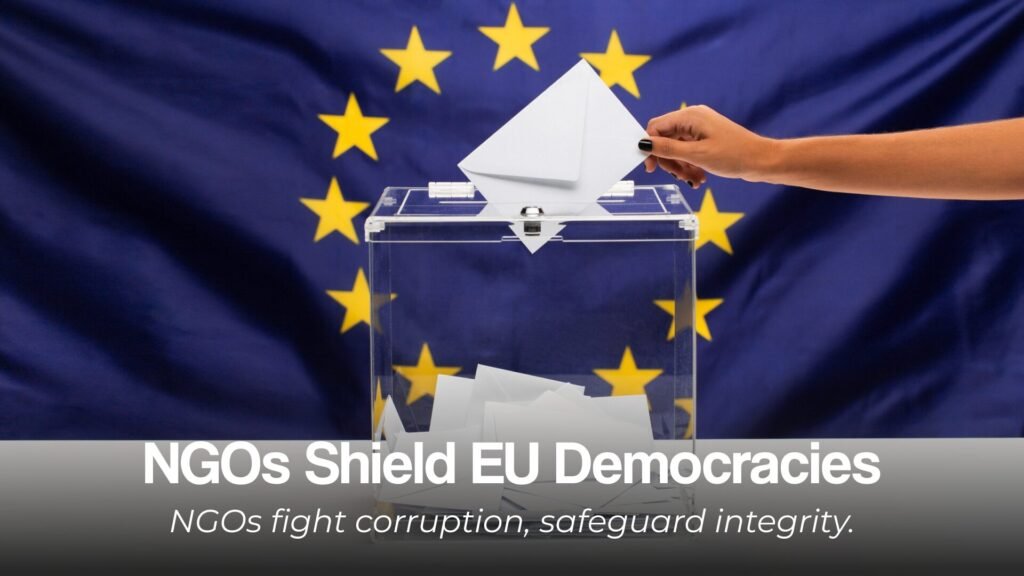
Anti-corruption non-governmental organizations (NGOs) serve as vital watchdogs in Europe’s democratic landscape, filling gaps left by governments in exposing graft, advocating reforms, and ensuring accountability. These groups operate independently, leveraging research, advocacy, and public engagement to combat systemic corruption that erodes public trust and distorts policy. Their work aligns closely with EU initiatives, amplifying efforts to harmonize anti-corruption standards across member states.
Key Anti-Corruption NGOs in Europe

Prominent NGOs lead the charge against corruption in Europe. Transparency International EU, established in 2008 as the EU liaison for the global movement, drives advocacy for stronger laws, enforcement, and public access to information across EU institutions. It collaborates with 22 national chapters in member states, focusing on integrity in decision-making and protecting public resources.
Other influential players include the Organized Crime and Corruption Reporting Project (OCCRP) and the International Consortium of Investigative Journalists (ICIJ), which excel in investigative journalism to uncover illicit activities. Platforms like the UNCAC Coalition’s Europe Anti-Corruption Platform unite over 40 civil society organizations from countries like Albania, Romania, and Serbia, fostering coordination on UN Convention against Corruption reviews.
Networks such as the European Partners against Corruption (EPAC/EACN) connect 60 authorities and oversight bodies, while groups like Coalition 2000 in Bulgaria have historically challenged governments through lobbying for policy changes. These NGOs often form coalitions, as seen in open letters signed by 57 organizations urging stronger EU Anti-Corruption Directive provisions.
Historical Impact and Success Stories
NGOs have driven landmark victories in Europe’s anti-corruption fight. Transparency International EU contributed to the 2019 Whistleblowing Directive, the highest global standard for protecting whistleblowers, approved by the European Parliament after intensive advocacy.
In Italy, the 1992-1994 “Clean Hands” investigation, supported by civil society, dismantled decades-old systemic corruption networks, leading to prosecutions and political upheaval. More recently, NGOs influenced the abolition of golden visa schemes in Ireland, the Netherlands, and restrictions in Portugal, aligning with a 2023 European Parliament report.
Investigative efforts by Bellingcat and ICIJ have accelerated detections, such as in the Qatargate scandal involving EU parliamentarians, prompting the 2023 EU Anti-Corruption Package. In Ukraine’s path toward EU integration, platforms like ProZorro—monitored by two dozen CSOs—exposed violations in 30,014 tenders worth $4 billion, saving funds and building trust.
Advocacy for EU Policies and Reforms

NGOs actively shape EU anti-corruption frameworks. They pushed for the 2023 Anti-Corruption Directive proposal, advocating criminal law harmonization, victim compensation, and NGO procedural rights to represent victims—provisions partially adopted despite Council-Parliament tensions.
Through the EU Network against Corruption, civil society exchanges practices with stakeholders, including the KLEPTOTRACE consortium involving research centers, law enforcement, and journalists across eight member states. Transparency International strengthened anti-money laundering rules in the EU’s 6th Directive, promoting beneficial ownership transparency despite court setbacks.
Lobbying targets include ending golden visas, enhancing beneficial ownership registers, and creating an EU Global Magnitsky Act to sanction corrupt officials. NGOs criticize biases in the EU Transparency Register, where CSOs face stricter funding disclosures than industry lobbyists, and call for open contracting data in the Open Data Directive.
Challenges Facing Anti-Corruption NGOs
Despite successes, NGOs encounter significant hurdles. Civic space shrinks as authoritarian regimes weaponize anti-corruption laws to suppress dissent, a blind spot in EU policy post-Qatargate. Funding scrutiny and unequal lobbying access disadvantage CSOs, fostering perceptions of undue influence while corporate lobbies dominate.
Implementation gaps persist; France’s beneficial ownership register shows non-compliance by a third of entities, linked to money laundering in real estate. Political resistance weakened the Anti-Corruption Directive, shortening statutes of limitations and diluting party financing transparency.
External threats like foreign interference and kleptocratic funding exacerbate issues, as seen in Hungary’s misuse of EU subsidies. NGOs stress open government—transparency plus participation—for sustainable reforms, yet EU efforts often prioritize technical fixes over multi-stakeholder engagement.
Case Studies: Tangible Democratic Gains
Italy’s Clean Hands Campaign: Civil society-backed probes from 1992-1994 toppled corrupt institutions, prosecuting hundreds and reshaping politics, proving NGOs’ role in national renewal.
ProZorro in Ukraine: This e-procurement system, monitored by CSOs, identified $4 billion in irregularities, influencing EU aspirants and highlighting citizen oversight’s power.
Qatargate Response: NGO pressure post-2022 scandal spurred the Anti-Corruption Package and networks like EPAC, enhancing cross-border coordination.
Golden Visa Reforms: Advocacy led to scheme abolitions, curbing money laundering via real estate and reinforcing democratic integrity.
These cases illustrate NGOs bridging enforcement gaps, informing voters, and sustaining reforms across government changes.
Future Role Amid Evolving Threats
As Europe faces rising kleptocracy—evident in Russia’s war enabled by tolerated corruption—NGOs must expand open data advocacy, like Italy’s OpenCoesione portal tracking €107 billion in projects via civic hackathons. The 2025 EU Directive mandates national strategies consulted with civil society, assigning dedicated anti-corruption units.
NGOs will monitor transposition by 2028, push lobbying registers, and counter civic space erosion. By fostering multi-level coordination—from Brussels to local levels—they ensure EU rules translate into practice, rebuilding trust eroded by scandals.
Their independence positions them to detect abuses of EU funds, influence peddling, and strategic corruption, vital for resilient democracies.
Source Links:
- https://europeandemocracyhub.epd.eu/blind-spots-in-eu-anti-corruption-efforts/
- https://commission.europa.eu/strategy-and-policy/policies/justice-and-fundamental-rights/democracy-eu-citizenship-anti-corruption/
- https://transparency.eu/our-mission/
- https://www.anticorruptionintergroup.eu/
- https://www.nationalacademies.org/read/26781/chapter/4
- https://commission.europa.eu/strategy-and-policy/policies/justice-and-fundamental-rights/democracy-eu-citizenship-anti-corruption/eu-network-against-corruption_en
- https://korruptiontorjunta.fi/en/international-cooperation
- https://www.transparency.org/en/our-impact
- https://www.transparency.org/en/press/civil-society-organisations-urge-eu-leaders-deliver-on-anti-corruption-standards
- https://www.transparency.org/en/news/how-transparency-international-fought-corruption-2023
- https://knowledgehub.transparency.org/helpdesk/anti-corruption-coalitions-examples-of-success-and-capacity-building
- https://uncaccoalition.org/anti-corruption-platforms/europe/
- https://www.transparency.org/en/news/will-the-eu-raise-anti-corruption-standards
- https://www.pism.pl/publications/the-eu-faces-challenges-in-anti-corruption-directive-negotiations
- https://vinciworks.com/blog/the-eus-new-anti-corruption-directive-what-comes-next/