What does dark money mean in Europe?
How Can Civil Society Monitor Public Tenders and Detect Corruption Risks?
Yan Sikorin
December 30, 2025
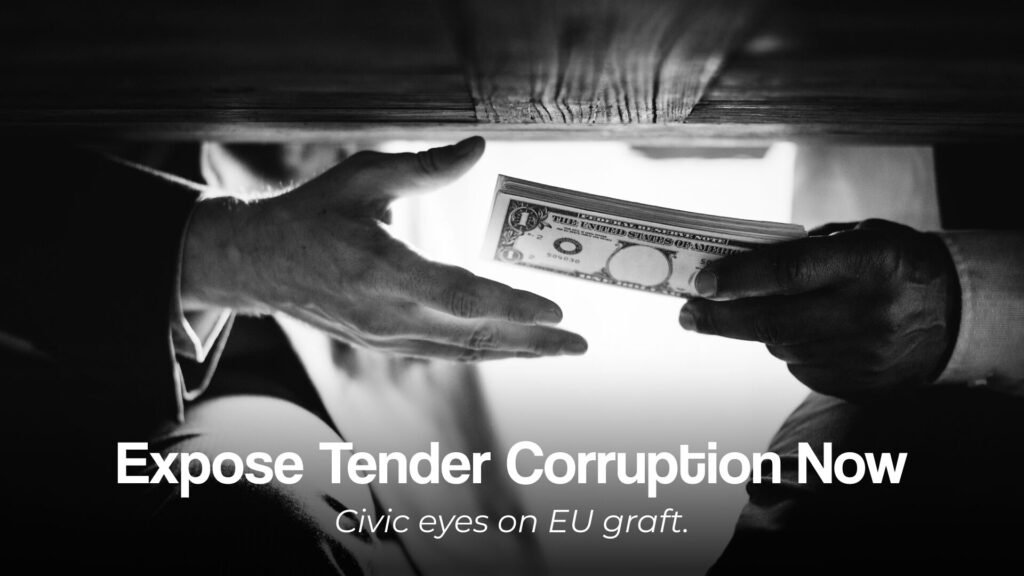
Public tenders in the European Union represent over €2 trillion annually in public spending, yet they remain rife with corruption risks like bid rigging and favoritism. Civil society plays a crucial role in monitoring these processes to enforce transparency and accountability, especially as EU funds fuel major infrastructure projects. This blog outlines practical strategies, tools, and real-world examples for detecting irregularities in EU tenders.
EU Tender Landscape
EU public procurement follows Directives like 2014/24/EU, mandating publication on the Tenders Electronic Daily (TED) portal for contracts above thresholds, ensuring EU-wide competition and transparency. Despite rules against splitting contracts to evade oversight, irregularities persist, with fraud potentially inflating costs by up to 50%. National portals in countries like Bulgaria, Greece, and Italy supplement TED, but data opacity hinders scrutiny.
Civil society accesses over 250,000 annual notices via TED, covering sectors from healthcare to highways. The EU’s e-procurement system from 2020 publishes hundreds of thousands of documents, enabling data-driven analysis. However, below-threshold contracts often escape full disclosure, amplifying risks in national budgets.
Key Corruption Risks

Common red flags include single-bid tenders, frequent amendments favoring incumbents, and conflicts of interest among bidders. Bid rigging occurs when firms collude to rotate wins, inflating prices, while technical specifications tailored to one supplier stifle competition. In EU-funded projects, political connections often award contracts without fair evaluation.
Data science identifies patterns like abnormal pricing or repeated winners in high-value sectors. For instance, over-reliance on negotiated procedures bypasses open bidding, a frequent issue in urgent infrastructure works. Geographic clustering of awards to local firms signals favoritism, distorting markets and eroding trust.
Essential Monitoring Tools
Civil society leverages platforms like Integrity Watch Red Flags, scanning 40,000 EU-funded and 320,000 national contracts with 20 risk indicators. Opentender.eu and iMonitor provide interactive maps, graphs, and daily updates for filtering by country, sector, or risk score. TED’s open data allows bulk downloads for analysis.
Integrity Pacts bind authorities, bidders, and monitors to anti-corruption charters, with CSOs overseeing compliance. Tools like Tender Defender board games train activists on risks. The EU’s Integrity Pacts Helpdesk offers templates and training for setup.
Tool | Coverage | Key Features | Source |
Integrity Watch Red Flags | 360,000+ EU/national contracts | Transparency International | |
Opentender.eu | 42 countries, EU focus | iMonitor/GPPD | |
TED Portal | All EU tenders above threshold | European Commission | |
iMonitor | High-risk EU tenders | Govtransparency |
Step-by-Step Monitoring Guide

Start by registering on TED and national portals like those in Poland or Romania for alerts on keywords or sectors. Scan for red flags: single bidders (risk of no competition), short notice periods, or unbalanced scoring.
Download notices in XML/CSV for analysis; use free tools like Excel or Python scripts to flag anomalies like price outliers. File freedom-of-information requests for unpublished details, then engage via public consultations. Join Integrity Pacts by partnering with authorities for full access and reporting channels.
Verify findings on-site or via whistleblowers, documenting with screenshots and timestamps. Escalate to the EU anti-corruption network or national auditors. Train teams using EU toolboxes for sustained impact.
- Query TED daily for your region.
- Cross-check bidders on business registries.
- Track amendments post-award.
- Mobilize networks for crowdsourced verification.
Integrity Pacts Success Stories
From 2016-2021, 15 CSOs monitored 18 EU projects worth €920 million via Integrity Pacts, addressing competition limits and boosting bids. In Czech Republic, TI monitored technical assistance contracts, influencing legislation for better procurement.
Greece’s flood pipeline monitoring exposed irregularities, leading to contract termination and policy reforms. Italy’s Sybaris archaeology site saw criteria changes, drawing more bidders and cost savings. Hungary’s M6 highway monitoring resolved transparency issues, earning the EU Ombudsman’s 2019 award.
In Romania, CSOs tracked digital platforms, preventing wasteful spending through citizen feedback tools. These cases across 11 states show civic oversight yields savings, fairer competition, and institutional trust.
Overcoming Government Pushback

EU governments often cite “commercial confidentiality” to withhold data, but Directives mandate transparency. Civil society counters with litigation standing under remedies directives, challenging awards harming public interest. In Bulgaria and Italy, iMonitor volunteers probed 100 contracts worth €140 million, sparking probes.
Build coalitions with sympathetic officials via EU networks. Use anonymous reporting on monithon.eu to shield monitors. Despite resistance, sustained monitoring—like in Moldova—drives reforms.
Building Capacity for Impact
CSOs need training in data analytics and procurement law; EU offers modules via REGIO. Partner with experts like Transparency International for methodology. Scale via communities of practice for authorities and monitors.
Fund through EU grants, focusing on high-risk sectors like construction. Measure success by red flags reduced, bids increased, and investigations launched. Long-term, embed civic monitoring in national laws for systemic change.
Source Links:
- https://ec.europa.eu/regional_policy/policy/how/improving-investment/integrity-pacts_en
- https://www.transparency.org/en/publications/monitoring-public-contracting-in-the-eu
- https://transparency.eu/integrity-watch-red-flags/
- https://imonitor.govtransparency.eu/
- https://european-union.europa.eu/live-work-study/public-contracts_en
- https://opentender.eu