What does dark money mean in Europe?
What does dark money mean in Europe?
Yan Sikorin
February 3, 2026
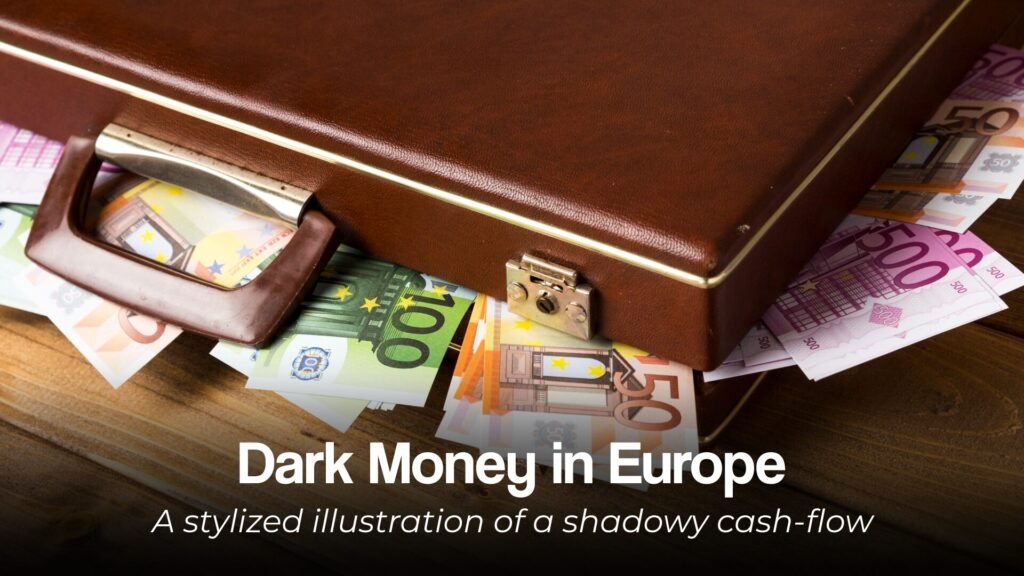
In European politics, “dark money” refers to political funding whose true source is hidden or deliberately obscured. It often arrives via anonymous donations, complex corporate structures, or foreign‑linked intermediaries that exploit weak disclosure rules. Unlike transparent public financing or clearly labeled party donations, dark money lets powerful actors influence laws, elections, and public opinion without accountability.
Across the EU, national rules on party funding vary widely. Some countries ban foreign donations; others allow them with minimal checks. This patchwork creates loopholes through which money can enter via friendly parties, think tanks, or NGOs before flowing into campaigns and media operations.
Main channels of dark money in Europe
1. Anonymous political donations
Investigations show that a large share of political donations in the EU are effectively anonymous. In Germany, for example, around 78% of party donations between 2019 and 2022 came from undisclosed donors, totaling hundreds of millions of euros. Because national laws permit small‑donation thresholds or “non‑cash” contributions, wealthy individuals and companies can bundle gifts or route them through intermediaries to stay off the public radar.
2. Foreign‑linked funding and loans
Foreign actors—including authoritarian states—have used loans and “consultancy” payments to support sympathetic European parties. A well‑known case is the €11 million loan from a Russian‑linked bank to France’s National Rally, which raised concerns about undue influence over a major eurosceptic force. Similar patterns appear in Central and Eastern Europe, where parties with close ties to Moscow‑aligned oligarchs receive opaque funding through offshore companies or local front firms.
3. Shell companies, tax havens, and money‑laundering routes
Dark money often passes through shell companies in secrecy‑friendly jurisdictions such as Cyprus, the British Virgin Islands, or certain EU‑based financial centers. These structures make it hard to trace whether a donation to a think tank, media outlet, or campaign comes from a domestic billionaire, a foreign oligarch, or criminal proceeds.
In some cases, proceeds of corruption or organized‑crime activity are laundered into European politics through property deals, consulting contracts, or “sponsorships” that never clearly disclose who ultimately pays.
4. EU‑level misuse of public funds
Even EU‑funded political groups have been accused of diverting money for partisan purposes. A leaked audit of the far‑right Identity and Democracy group in the European Parliament suggested that tens of millions of euros in EU operational funds were spent on questionable contracts and activities, blurring the line between public resources and party‑level campaigning.
These cases show that dark money is not only about private donations; it can also involve the misuse of public money through opaque staffing, consultancy, or subcontracting arrangements.
Why dark money matters for democracy?
When political influence is bought in secret, voters lose the ability to judge whether policies serve the public or private interests. Studies by Transparency International and others warn that covert foreign funding of electoral campaigns can be used by authoritarian regimes to elect sympathetic politicians who then weaken rule‑of‑law institutions or block EU‑level reforms.
Dark money also fuels public distrust. When scandals break—such as MEPs caught in bribery schemes or parties exposed for hiding donor identities—citizens see politics as a closed, corrupt system rather than an open democratic process. This erosion of trust makes it easier for populist and extremist movements to claim that “all politicians are the same,” further destabilizing European democracies.
How dark money shapes policy and elections?
1. Steering legislation behind the scenes
Anonymous donors and foreign‑linked actors often target specific policy areas such as energy, migration, or digital regulation. By funding parties, campaigns, or advocacy groups that favor certain outcomes, they can shift legislative priorities without ever appearing on an official donor list.
For example, research into Russian strategic corruption highlights how pro‑Kremlin networks have supported parties and media outlets that oppose sanctions, NATO integration, or EU‑level anti‑corruption measures.
2. Distorting election campaigns
Dark money can tilt campaign spending by financing parallel structures—online advertising networks, data‑analytics firms, or “independent” media platforms—that effectively act as extensions of political parties. In some countries, crypto‑based donations are emerging as a new channel, allowing donors to contribute without clear identification or audit trail.
This uneven playing field disadvantages smaller parties and civil‑society groups that rely on transparent, small‑donor funding, while advantaging those with access to hidden or foreign capital.
3. Current EU and national safeguards
The EU has taken steps to improve transparency, including rule‑of‑law conditionality and calls for stricter party‑financing rules. However, enforcement remains patchy, and many member states still allow foreign donations or tolerate large volumes of anonymous contributions.
Organizations such as Transparency International and academic researchers repeatedly call for:
- A full ban on non‑EU funding of political parties and candidates.
- Centralized, real‑time disclosure of all donations above a low threshold, including the names of ultimate beneficial owners.
- Stronger anti‑money‑laundering checks on political financing and related corporate structures.
Some countries, such as Austria after the Ibiza‑affair, have tightened rules and now require disclosure of donors above modest amounts, showing that reform is possible.
What can be done to cut off dark money?
1. Close legal loopholes
Harmonizing party‑financing rules across the EU would make it harder to route money through the most permissive jurisdictions. A clear ban on anonymous donations above a small threshold and on foreign‑state funding of parties would remove two of the biggest channels.
2. Enforce beneficial‑ownership transparency
Public registers of company owners already exist in many EU countries, but they are often incomplete or poorly enforced. Requiring political actors and their contractors to disclose ultimate beneficial owners would make it much harder to hide who is really paying for influence.
3. Strengthen independent oversight
Experts recommend creating dedicated anti‑corruption and campaign‑finance oversight bodies at both national and EU levels, with real investigative powers and access to financial intelligence. These bodies could audit party‑finance declarations, flag suspicious patterns, and refer cases to prosecutors.
4. Empower journalists and civil society
Investigative outlets and NGOs have repeatedly exposed dark‑money networks, from Russian‑linked media operations to MEPs involved in bribery schemes. Protecting press freedom, funding investigative journalism, and enabling access to public‑interest data are essential to keep dark money visible.
Source Links:
- https://ecfr.eu/publication/dark-money-politics-why-europe-should-join-bidens-fight-against-corruption/
- https://www.dw.com/en/do-eu-structures-enable-far-right-misuse-of-public-money/a-73156915
- https://www.bushcenter.org/publications/targeting-european-politics
- https://www.transparency.org/en/news/political-corruption-in-europe-threat-to-public-funds-integrity-watch
- https://vsquare.org/transparency-gap-eu-political-donors-parties-public/
- https://www.europarl.europa.eu/RegData/etudes/BRIE/2019/608873/IPOL_BRI(2019)608873_EN.pdf
- https://www.spotlightcorruption.org/crypto-donations-dark-money-threat/
- https://www.thebureauinvestigates.com/stories/2024-10-09/illegal-donations-how-dark-money-gets-into-uk-politics
- https://www.europeancircuit.com/event/dark-money-2025/